
Middle East
U.S. F-35A Broadcasts Emergency Code 7700 Over Eastern UAE, Flight Data Show
Public flight-tracking data show a U.S. Air Force F-35A squawking the 7700 emergency code over the eastern UAE on Saturday, Nov. 21. The cause, any damage and where it landed have not been confirmed, and the U.S. military has not commented.
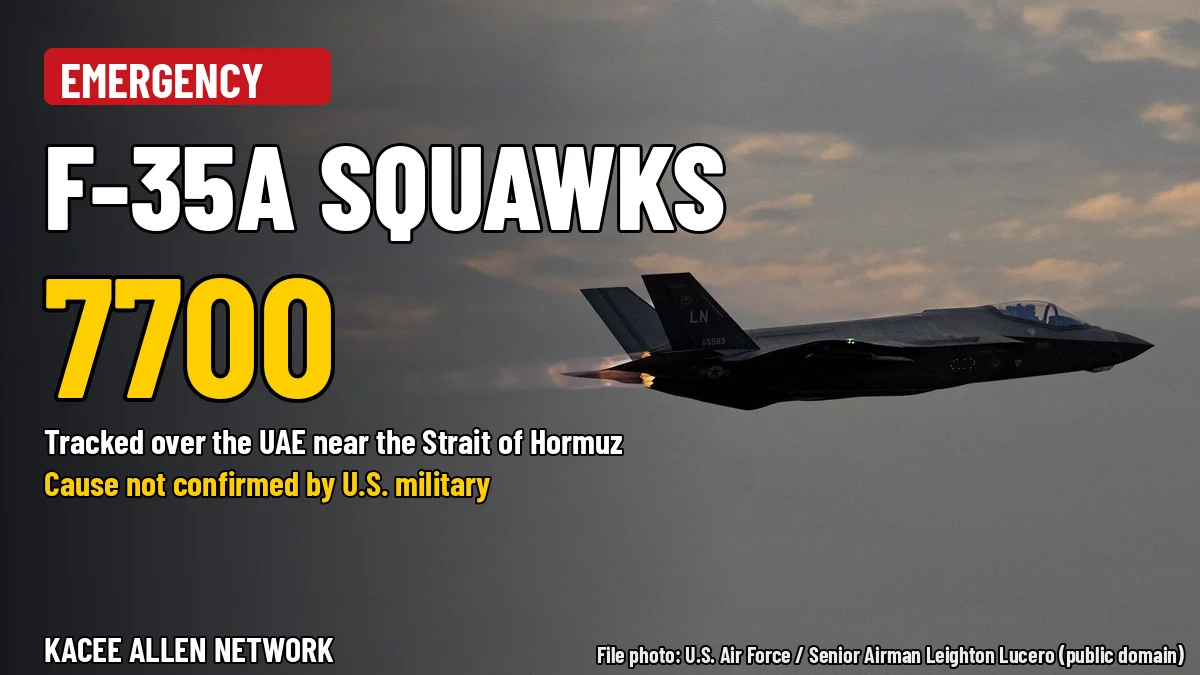
A U.S. Air Force F-35A Lightning II broadcast transponder code 7700, the universal signal for an in-flight emergency, while flying over the eastern United Arab Emirates on Saturday, according to public flight-tracking data reviewed by Kacee Allen Network. The cause is unknown, and the U.S. military had not commented by Saturday evening.
The jet drew attention when Arya Yadegaar, who posts as @FotrosYadegaar on X, shared a Flightradar24 screenshot at 4:48 p.m. Eastern. It shows call sign F35LTNG, listed as an F-35A with Air Force serial 13-5067, squawking 7700 at about 8,840 meters and roughly 911 kilometers per hour. Yadegaar wrote that the fighter had flown above the Strait of Hormuz and was likely headed for Al Dhafra Air Base near Abu Dhabi.
What the tracking data show
Kacee Allen Network checked the claim against a second, independent network of volunteer ADS-B receivers. It logged the same call sign on aircraft address AF351F, an F-35 in its database, squawking 7700 at 29,000 feet at 21:41 UTC, which was 4:41 p.m. Eastern and 1:41 a.m. Sunday in the UAE. The jet was about 20 kilometers north of the city of Fujairah, over the mountains of the eastern UAE. A second fix 42 seconds later put it about 11 kilometers to the southwest, toward Al Dhafra.
Those two fixes are all the network recorded, and both were calculated from signal timing at several ground receivers rather than broadcast by the jet. They do not show where the fighter had been earlier, and they do not place it over the strait itself; the logged position is about 100 kilometers south of its narrowest point. Nothing Kacee Allen Network found shows where, or whether, it landed.
Under Federal Aviation Administration guidance, pilots set code 7700 for a distress or urgency condition, and it triggers an alarm on air traffic control screens. The code alone does not reveal the cause.
A tense day in the Gulf
The U.K. Maritime Trade Operations center said a tanker leaving the Gulf was hit on the stern by an unknown projectile early Saturday about 11 nautical miles north of Khasab, Oman, and The Associated Press reported at least three tankers struck in or near the strait. Bahrain told residents to seek safe locations and said an Iranian attack set a civilian industrial site on fire.
Hours earlier, U.S. Central Command rejected an Iranian claim that air defenses had damaged an American F-16 over the Gulf on Friday. “Iran did not attack a U.S. F-16 fighter aircraft yesterday — at all,” CENTCOM said, adding that all U.S. fighter jets in the region were “safe and accounted for.” Reuters noted that Iran has made similar claims since the war began with U.S. and Israeli strikes in February, and that the U.S. military has denied them. Iran’s Fars news agency also reported an F-35 squawking 7700 near the UAE on Nov. 16; that was never officially confirmed.
What is not known
There is no official word on why the F-35A declared an emergency, whether it was damaged, or where it landed. Some accounts online suggested Iranian fire; nothing Kacee Allen Network found supports that, and it should be treated as speculation. We will update this story if CENTCOM or the Air Force comments.
Editor’s note: This report began with a Nov. 21, 2026, post on X by @FotrosYadegaar that included a Flightradar24 screenshot. Kacee Allen Network confirmed the call sign, aircraft address, emergency code, altitude, time and position in an independent ADS-B network’s archived track for aircraft AF351F. The meaning of code 7700 is from the FAA’s Aeronautical Information Manual. The cause, any damage and the landing site are unconfirmed. Neither the Air Force nor CENTCOM had commented at publication, and no one was interviewed.